
Ginsberg Centennial
A Tribute and a Remembrance

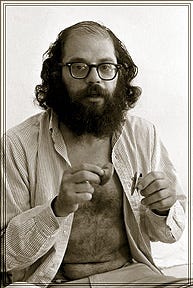
Today would be the 100th birthday of poet, protester, provocateur, and all-around public pest (in the best ways), Allen Ginsberg. Of those p words, POET should be capitalized because, for all his flamboyance, Ginsberg was a masterful and innovative artist (one collection won the 1974 National Book Award) and a lifelong student of verse who served as Distinguished Professor of English and Creative Writing at Brooklyn College in the last decade of his life.
I’ll leave it to others to discuss—or, as has often been in case—argue about Ginsberg’s status in the poetry pantheon. What can’t be argued is that his public presence resembled that of a folk singer or rock star more than that of a scholarly poet. He was controversial from the start. “Howl,” by far his most famous poem, was so graphic, so explicit, so inflamed that it landed in the reader’s mind as much like a scream as the written word. It caught the attention not only of the literati and of the beatniks and Beat-adjacent of Greenwich Village and North Beach, but of the moral police. The famous 1957 obscenity trial, like most attempts at censorship, resulted in exoneration, and the publicity vastly multiplied the poem’s readers, enhanced the publisher’s business model, and made Ginsberg something of a celebrity and Beat poetry a genre in itself.
Long after Jack Kerouac, the best-known of the Beats for his novel On the Road, descended into alcoholism (he died in 1969), Ginsberg remained in the public eye. He was omnipresent at antiwar protests, civil rights demonstrations, and nuclear disarmament rallies. He was outspoken (to put it mildly) both verbally and in verse about every conceivable social justice issue, always anti-materialism, anti-militarism, anti-corporatism, anti-banning of recreational drugs, and anti-sexual repression (he advocated for gay rights when homosexuality was almost universally regarded as a perversion). And when the beatniks gave way to the hippies, Ginsberg was there, in the forefront, at be-ins and love-ins and, it seemed, wherever humans gathered to celebrate freedom of any kind.
All of which is a matter of a history, and your favorite search program will deliver the details in an instant. I’ll segue now to my personal expertise.
Ginsberg was a force in the transmission of Eastern spiritual wisdom to America. As I wrote in American Veda, “The Beats were called poets of revolt, but as Ginsberg would later remark, theirs was a revolt of consciousness, not just of politics and social mores.”
It started with the well-known linkage of the Beats and Zen. For quite some time, if Americans knew anything about Buddhism it was because of that association and the works of Ginsberg, Kerouac, Gary Snyder (the most committed Zenster of the lot), and others. Later, Ginsberg formed a close relationship with Chögyam Trungpa Rinpoche, the Tibetan Buddhist teacher in Boulder, Colorado. He studied at Trungpa’s Naropa Institute and taught poetry there formalizing a commitment to the Buddhist path in 1972, when he took refuge in Boddhisattva vows.
But Ginsberg also had a Hindu streak centered primarily on the devotional path known as bhahti. He spent more than a year in India in the early sixties, visiting ashrams, meeting gurus, and hanging out with the mystical poets known as the Bauls. Back in New York, he encountered A.C. Bhaktivedanta Swami Prabhupada, the founder of the Hare Krishna movement, who had settled in Ginsberg’s East Village neighborhood. They formed a close relationship and Ginsberg could be seen chanting with the Krishnas in public spaces like Tompkins Square Park.
Then he helped take the show on the road, helping Prabhupada take Krishna bhakti to the West Coast. From American Veda: “Throughout that period, the media frequently displayed images of the counterculture’s poet laureate dancing with the Hare Krishnas, intoning om to pacify political rallies, and chanting mantras at flower power gatherings.” His mantra pacification efforts, I might add, extended to massive antiwar demonstrations and the explosive 1968 Democratic National Convention in Chicago.
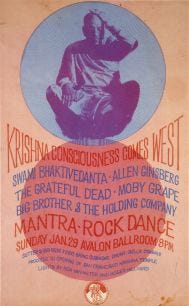
But he was also a leading presence at the love bombings of the era. Quoting myself again: “In January 1967 Bay Area newspapers ran headlines like SWAMI INVITES HIPPIES TO HIPPIELAND TEMPLE. Posters appeared for a ‘Mantra-Rock Dance’ at the Avalon Ballroom, which was second only to the Fillmore as a rock mecca. The event, presided over by Bhaktivedanta and Ginsberg, featured the Grateful Dead, Big Brother and the Holding Company (with lead singer Janis Joplin), and other stars of the promiscuous, drug-driven scene. They were joined onstage by the celibate, drug-rejecting, vegetarian musicians of the newly established International Society for Krishna Consciousness (ISKCON).”
In one of the great moments in TV history, circa 1968, Ginsberg was interviewed by the straightest-of-the-straight conservative ideologue, William F. Buckley, on PBS’s Firing Line. At one point, he picks up his harmonium and belts out the Krishna maha mantra as Buckley looks on in polite befuddlement. Ginsberg said he did in recognition of “the unity of being, and of that great consciousness that we are all identical with.” I love playing this clip in presentations:
Finally, a personal note. In the mid-90s, when I lived in Los Angeles, I was friends with someone who happened to be Allen Ginsberg’s cousin. As a result, my wife and I had dinner at the friend’s home twice when Allen was his guest.
Here’s what I remember most about those two memorable occasions: Allen talking about being a gay man in the 1950s, about his fondness for much younger men, about Bob Dylan as a troubadour poet, about his diabetes, and about Gregory Corso, whom he called the best pure poet among the Beats and a sad victim of drug addiction—and me, in turn, telling Allen about Gregory’s father and half-brother, whom I knew very well as an adolescent in Brooklyn.
On the second occasion, about a year before he passed in 1997, his health was clearly in decline. I was asked to drive him to his poetry reading. He was quiet on the ride and seemed frail and weary. I dropped him off and sat down in the audience, wondering how he could possibly go onstage. But he did, totally transformed. He walked erect and grinned to the applause, then sat down, started playing the harmonium, and launched into a spirited rendering of William Blake’s “The Tyger” (Tyger Tyger, burning bright / In the forests of the night …). Then he recited his own works, old and new, and was every inch the full-throated, wild-eyed, in-your-face provocateur I’d seen read at my college more than forty years earlier and would occasionally spot crossing a street in the East Village. To the end, it seemed, he knew he was a messenger, and the message must go out and the show must go on.
Beautiful
I’m Philip Beeman from Ottawa